
For a three- or four-day Chicago trip, choose Midway when it offers a nonstop at a sensible time and your hotel is in the Loop or South Loop. Its smaller footprint and shorter Orange Line ride can return close to an hour across arrival and departure. Choose O'Hare when its much broader schedule avoids a connection, gives you a better arrival, or places you closer to a north or northwest-side stay.
That is the useful answer, not a universal winner. A smaller airport cannot save time if its limited schedule forces a late arrival, and a fast flight into O'Hare can still feel slow when a family crosses a large terminal and then rides into town. Compare the whole trip from your front door to the hotel lobby, including bags, terminal walking, transit hours, and the neighborhood where you will actually sleep.
Who Should Choose Midway, and Who Needs O'Hare?
Midway is the cleaner fit for couples and families taking one nonstop flight, packing lightly, and staying near the Loop. Chicago's airport authority lists about 234 daily nonstop departures to 94 domestic and international destinations as of September 2026. That is a useful network, but it is concentrated enough that your home airport and travel day may leave only one or two workable choices.
O'Hare is the safer default when schedule depth matters. The airport authority lists roughly 1,289 daily nonstop departures to 257 domestic and international destinations. Travelers coming from smaller cities, arriving internationally, or staying near River North, Wicker Park, Logan Square, Rosemont, or the northwest suburbs are more likely to gain from that reach. The airport is larger, so the winning O'Hare itinerary is one that uses its network instead of merely tolerating it.
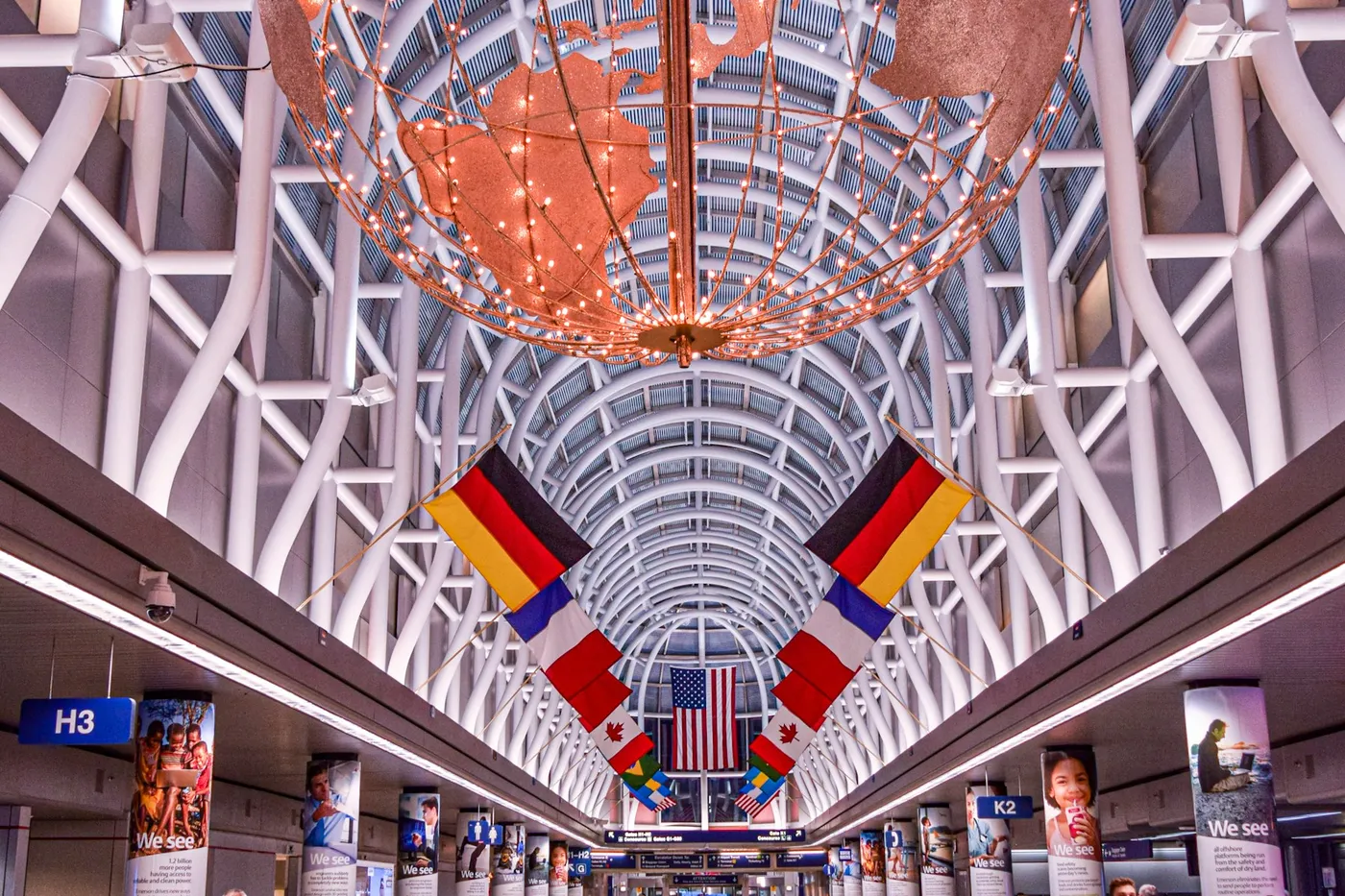
The Choice Is Network and Scale, Not Just Miles from Downtown
Midway has one terminal complex with Concourses A, B, and C branching from a central security area. That compact layout makes the path from gate to baggage claim easier to understand, especially when children are tired or everyone has a rolling bag. It also means less recovery time after landing before you are moving toward the city.
O'Hare has four passenger terminals connected by the Airport Transit System, with the Blue Line station reached from the domestic terminal core. A Terminal 5 arrival adds an airport-train transfer before the city train. None of this makes O'Hare a bad choice, but it belongs in the calculation. If two flights have similar times and prices, Midway's scale is a real advantage. If O'Hare turns a connection into a nonstop or offers an early Friday arrival instead of a late one, its larger footprint is a fair trade.
Calculate Gate to Hotel, Not Runway to Downtown
CTA's practical planning range is about 45 to 50 minutes between O'Hare and downtown on the Blue Line. The Blue Line runs around the clock, which matters after a delayed evening flight. From Midway, the Orange Line typically takes about 25 to 30 minutes to the Loop, but it is not a 24-hour service. Add the walk from the gate, baggage claim, the station connection, and the final walk or transfer to your hotel.
For a Loop hotel, Midway can save roughly 20 minutes on the train in each direction, then often a little more inside the airport. That can become 45 to 60 minutes across a weekend. The math changes north of downtown. A Blue Line hotel in Wicker Park or Logan Square can make O'Hare the faster door-to-door choice, while an Orange Line traveler would pass through the Loop and change trains or take a car back north.
A family with two checked bags should also count effort. A direct taxi may be worth more after bedtime than a theoretical rail advantage. In normal conditions, Chicago's airport authority cites an average downtown taxi fare of about $35-$40 from Midway, while O'Hare fares vary with traffic and destination. Treat either estimate as a planning guide, not a promise.
Compare the transfer that fits your arrival
Price the same pickup time, passenger count, luggage, and hotel address before deciding that rail or a private ride is the better value.
Compare Chicago airport transfers ➜
Let the Hotel Neighborhood Break a Close Tie
For first-time visitors who want Millennium Park, the Art Institute, the riverwalk, and easy rail connections, a Loop base keeps the arrival simple from either airport. The Chicago Athletic Association faces Millennium Park, the Palmer House sits near several train lines, and the Royal Sonesta Chicago Downtown puts the river just outside. These are location examples, not a reason to cross the city for a particular brand.
Midway gets the edge for Loop and South Loop hotels because the Orange Line arrives on the elevated Loop tracks. O'Hare gets more interesting for River North or neighborhoods along the Blue Line. Look at the final station-to-lobby walk with luggage, not only the hotel's neighborhood label. A ten-minute walk that feels easy on Saturday morning can feel quite different after a delayed Friday flight with a sleepy child.
If arrival and hotel are still undecided, compare the combined flight and room total only after matching cancellation terms, bag rules, arrival times, and hotel location. A lower headline total is not a bargain if it trades away Friday evening.
Compare the flight and hotel as one decision
Keep the neighborhood, room type, bag assumptions, and cancellation terms consistent so you can see whether the airport choice actually changes the weekend.
Compare flight and hotel options ➜Drive Only When the Suburban Side of the Trip Justifies It
Parking can erase the convenience of arriving in your own car. At O'Hare, official economy options currently range from $16 to $30 per day, with a shuttle or Airport Transit System ride between the lot and terminal. Midway has terminal and economy parking, and its economy facilities sit west of the terminal with shuttle service. Always check live lot status before leaving home because the lowest-priced lot may fill.
A car still makes sense when you are starting in the suburbs, carrying equipment, visiting relatives beyond the rail network, or splitting the weekend between downtown and a distant destination. For a downtown-only stay, leave it behind. Hotel parking, traffic, and repeated retrievals consume the same scarce hours you were trying to protect by choosing the right airport.
Pay More Only When It Buys Back a Usable Block of Time
A modestly higher O'Hare fare can be the better value if it buys the only nonstop, avoids a connection, or lands early enough for dinner. A higher Midway fare can win when it shortens both terminal and ground time for a Loop stay. Compare arrival time first, then total travel time, then price. That order keeps a small airfare difference from controlling a much larger vacation decision.
The same logic applies to an airport hotel. A night near O'Hare is useful for a very early departure, a late international arrival, or separate family flights that need a meeting point. It is usually a poor use of a three-night city break when everyone lands by early evening. Near Midway, an airport hotel is mainly a schedule tool for a pre-dawn departure, not a sightseeing base.
Avoid the Mistakes That Turn the Faster Airport into the Slower One
- Do not assume Midway always means downtown faster. A north-side hotel can reverse the advantage after a transfer.
- Do not treat every O'Hare terminal the same. Terminal 5 can add an Airport Transit System ride before you reach the Blue Line.
- Do not plan a late Midway arrival around all-night rail. Check the current Orange Line timetable for your date; the Blue Line is the airport route with 24-hour service.
- Do not compare fares without bag rules. A family checking luggage needs the total and the baggage-claim time, not the first number shown.
- Do not switch airports on a connection. The airport authority advises allowing up to two hours just for the CTA trip between O'Hare and Midway.
Before departure, use the official CTA trip planner and the airport's live parking and terminal information. One current check is more useful than memorizing a perfect-case travel time.
Level Up with a Better Arrival, Not a Fancier Seat
On a short domestic hop, the most valuable upgrade is often the flight that lands at 3 p.m. instead of 8 p.m. That earlier arrival can create a relaxed first dinner and a full night's sleep, which does more for the weekend than a premium seat on a two-hour flight. Pay for extra legroom when someone in your group needs it, but do not let the cabin distract from the schedule.
A prearranged transfer is the other sensible upgrade after a late arrival, with children, or when mobility needs make two rail connections tiring. Skip it when you land in daylight with light bags and your hotel is an easy walk from the Blue or Orange Line. Chicago is one of the rare US cities where both major airports have direct rapid transit, so use that advantage when it fits.
Choose the Airport That Protects Your Chicago Weekend
Midway wins the close contest for a Loop-centered weekend with a good nonstop schedule. O'Hare wins when its network removes a connection, improves the arrival time, or lines up with a Blue Line or northwest-side base. Neither airport wins by name alone.
Put both viable itineraries on one line: home departure, landing, terminal exit, hotel arrival, and return buffer. The airport that preserves the most usable Chicago time without creating a fragile plan is the right one. On a three-night trip, that is the difference between merely reaching the city and actually having Friday evening there.
This article contains affiliate links. If you book through them, The Trip Deck may earn a commission at no extra cost to you. See our Affiliate Disclosure Policy.